Real cyber scenarios.
Executive pressure.
Tabletop exercises, critical-infrastructure scenarios, and executive + technical crisis drills. Built around documented intrusion sets — not theoretical playbooks. Every engagement closes with a signed After Action Report ready for the audit shelf.
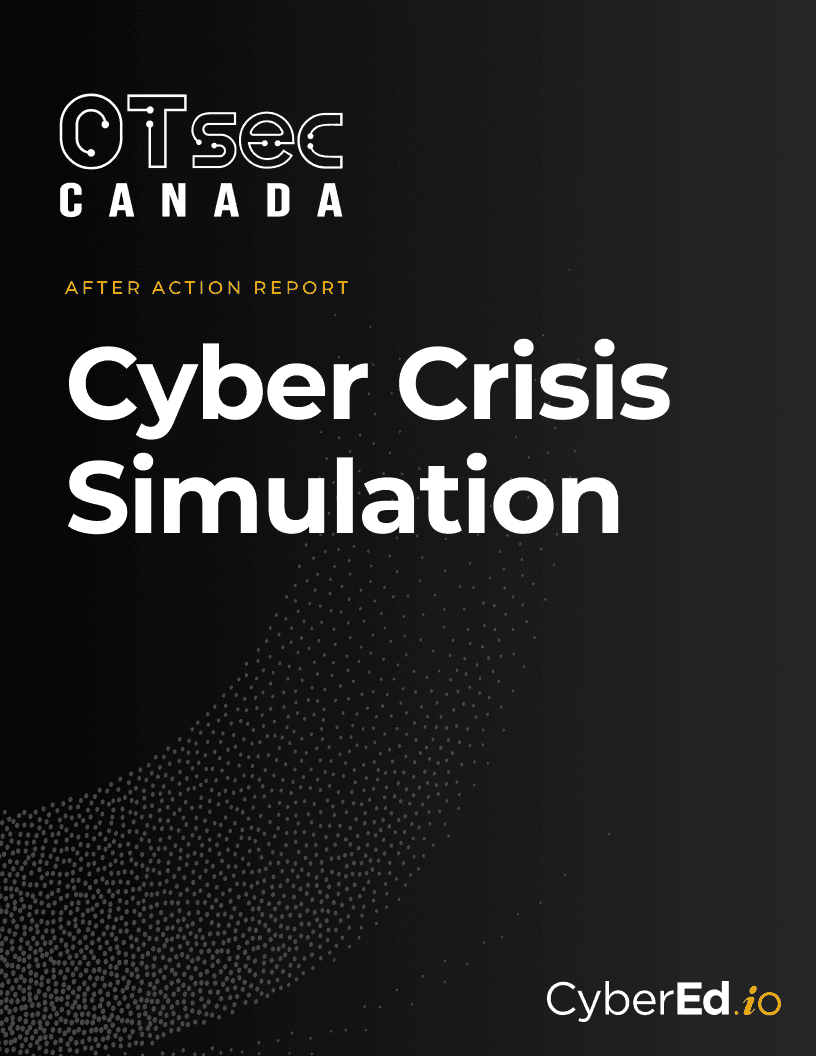
Typical AAR · 40+ pages · delivered within 10 business days
Audit Crosswalk
Every finding maps to NIST CSF 2.0, and to the frameworks that matter in your industry — ISO 27001, CIS Controls, CMMC, HIPAA, NERC CIP. Walk into your next audit with the evidence already assembled.
Follow-up Exercise Recommendations
A concrete next-tabletop roster — tuned to the exact gaps this exercise exposed. We don't close with a vague 'do better next time.' We hand you the scenario brief for round two.
5-Phase Scenario Scoring
Performance is graded per phase — opening wedge · indicators · public exposure · crisis climax · aftermath. Leadership sees precisely where response decayed, not a single number.
Threat Actor Profile
Each scenario is anchored to a documented adversary — motive, capability, historical campaigns. The pressure in the room maps to an attacker your board has already read about.
Five phases of a crisis your team will run in a room.
A representative scenario — not a live engagement. Real exercises are scoped to your industry, threat model, and leadership structure. Every phase has decision points, a clock, and observers scoring the response.
The adversary maps the attack surface with LLM-automated OSINT — scraped executive profiles enriched by a model, earnings-call transcripts fed back for CFO communication patterns, public repos combed for leaked keys. A 90-second voice sample of the CEO is lifted from a quarterly webinar and cloned. By the time recon ends, the attacker has a higher-fidelity map of the reporting chain than HR does.
An AI-generated spear-phishing wave, tuned per-recipient, slips past the email classifier — the language is too novel to hit a signature. The voice-cloned CEO calls the CFO on WhatsApp to pre-authorize a wire. A mid-morning MFA push-fatigue prompt is accepted during an otherwise legitimate login. First-party access is now held by the adversary; preventive controls held against the old playbook, not this one.
EDR flags anomalous PowerShell on a build runner. A deepfake voice call from a manager tells the on-duty analyst to stand down — the ticket is marked as a planned change. Alert history has been salted over prior weeks with AI-generated noise, making the real indicator statistically unremarkable. Mean time to detect: 38 hours.
Domain controllers encrypt. The ransomware negotiator is an adaptive AI agent — multilingual, patient, able to mirror counsel's tone. Mid-response, an AI-generated disinformation campaign alleges the company leaked the data on purpose. Leadership is defending on two fronts: restoration and narrative. Outside counsel, comms, and the CISO have 90 minutes to align before the next market-open window.
Restoration uncovers a second finding: the ML fraud-detection model was quietly retrained during the intrusion — data-poisoning in production. 72-hour regulatory clocks open in three jurisdictions. The insurance adjustor asks about model-lifecycle controls and AI-governance policy. The board directs a post-mortem that now has to cover not just the breach, but the AI surface the company didn't know it had.
Ready to put your leadership in a room?
Scope a simulation around your threat model, regulatory posture, and crisis-response chain of command. Ship the AAR to your board, your auditor, and your next exercise.